Project Note
Practical context for engineering decisions.
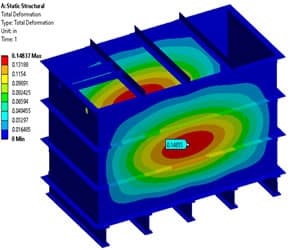
Structural analysis example for evaluating hydrostatic pressure loading, wall response and reinforcement needs in a water tank under filled operating conditions.
Project objective
This hydrostatic FEA project evaluated the structural response of a water tank under fluid pressure loading. The goal was to understand how the tank walls, support regions and overall geometry behaved when subjected to filled operating conditions.
Why hydrostatic loading needs simulation
Fluid pressure increases with depth and creates a nonuniform load distribution across the tank structure. For larger tanks or designs with flat panels, corners and local supports, this can lead to stress concentration and deformation that may not be obvious from simple hand estimates alone.
What the analysis helps identify
The simulation helps reveal where panel deflection becomes significant, where reinforcement may be needed and whether local features experience elevated stress under the hydrostatic load. This gives the engineering team a clearer picture of which structural areas control performance and safety.
Supporting reinforcement and thickness decisions
Results from this kind of study can guide wall thickness changes, stiffener layout, support modifications and material decisions. That improves confidence in the tank design while avoiding unnecessary overdesign in areas that do not require additional reinforcement.
How FEAmax supports tank and pressure-loaded structures
FEAmax supports hydrostatic and pressure-related structural analysis for tanks, housings and industrial equipment where contained fluid loading affects design reliability. The focus is on practical simulation output that helps customers make sound reinforcement and fabrication decisions.
What to send for review
- Project objective and current design concern
- CAD files, drawings, sketches or photos
- Material, load, flow or operating conditions
- Schedule target and required deliverables