Project Note
Practical context for engineering decisions.
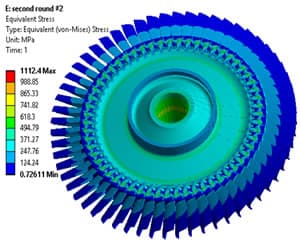
Fatigue assessment example for a turbine blade where cyclic stress, local concentration and repeated service loading affect usable component life.
Project objective
This fatigue analysis reviewed the durability of a turbine blade exposed to repeated service loading. The purpose was to understand how cyclic stress affected expected life and where local stress concentration could shorten performance reliability.
Why turbine blade fatigue matters
Turbine blades operate in environments where repeated loading, vibration and stress cycling can gradually reduce structural life even when peak stress is not immediately catastrophic. Fatigue analysis helps determine whether the component has enough life margin for the intended operating profile.
What the engineering review considered
A study like this typically examines stress distribution, critical regions near geometric transitions and how repeated loading may accumulate damage over time. These results help identify whether the blade geometry or local features require attention before long-term service use.
Using the result to improve service life
Fatigue results can support decisions such as refining blade geometry, smoothing local transitions, changing material strategy or adjusting operating assumptions. That gives the design team a more defensible path for improving durability than relying only on field failure history.
How FEAmax supports fatigue-critical components
FEAmax supports fatigue and durability analysis for rotating and structural components where cyclic loading governs product life. The objective is to identify the real life-limiting regions and help customers improve reliability before costly failures occur.
What to send for review
- Project objective and current design concern
- CAD files, drawings, sketches or photos
- Material, load, flow or operating conditions
- Schedule target and required deliverables